Dragon Ball Z picks up the story five years after the end of Dragon Ball. Broadcast by Fuji TV from April 26, 1989 to January 31, 1996, it is the longest series in the franchise at 291 episodes, and the one that turned Dragon Ball into a worldwide phenomenon. It adapts volumes 17 to 42 of Akira Toriyama's manga and spans more than twenty years of Goku's life, from the arrival of his brother Raditz to his departure with young Uub.
Dragon Ball Z episodes
291 episodes across 7 sagas, each with a recap and our review. Open a saga or start from the very first one.
What it is about
Goku, now the father of Gohan, learns that he is a Saiyan, a member of an alien warrior race that sent him to Earth as a baby to conquer it. A blow to the head made him forget the mission. From there the series opens up to space: invaders, galactic emperors, androids and ancient demons push Goku and his friends to break their limits over and over again.
The first threat is Vegeta and Nappa, the Saiyans who come to avenge Raditz. To revive their fallen friends, Gohan, Krillin and Bulma fly to Namek, where they run into the tyrant Frieza: their clash produces the first Super Saiyan transformation. Then come Trunks from the future, Dr. Gero's androids and Cell, defeated by a teenage Gohan at the Cell Games. Seven years later the series hands over to a new generation, with kid Goten and Trunks, and closes with Majin Buu, fusion and a Spirit Bomb powered by the whole Earth.
Sagas and episode counts
The story falls into four big arcs, Saiyan, Frieza, Cell and Majin Buu, plus two anime-only detours: Garlic Jr., between Frieza and Cell, and the Other World Tournament, between Cell and Buu. The table follows the nine seasons of Funimation's release, the most widely used division with episode numbers.
| Season | Episodes | No. | Content |
|---|---|---|---|
| 1 | 1–39 | 39 | Saiyan Saga: Raditz, Vegeta and Nappa |
| 2 | 40–74 | 35 | Namek and the Ginyu Force |
| 3 | 75–107 | 33 | Frieza and the first Super Saiyan |
| 4 | 108–139 | 32 | Garlic Jr., Trunks and the androids |
| 5 | 140–165 | 26 | Imperfect and Perfect Cell |
| 6 | 166–194 | 29 | The Cell Games |
| 7 | 195–219 | 25 | Other World, Great Saiyaman and the tournament |
| 8 | 220–253 | 34 | Babidi and Majin Buu |
| 9 | 254–291 | 38 | Fusion, Kid Buu and the epilogue |
Main characters introduced
- Gohan, Goku's son and the real hero of the Cell arc;
- Raditz, Vegeta and Nappa, the Saiyans; Vegeta becomes the eternal rival and later an ally;
- King Kai, Goku's teacher in the afterlife;
- Frieza and the Ginyu Force, the face of the cosmic threat;
- Dende, the young Namekian who will become Earth's new guardian;
- Trunks, son of Bulma and Vegeta, both as a time traveler and as a kid;
- Android 17, Android 18 and Cell, Dr. Gero's creations;
- Goten, Videl and Mr. Satan (Hercule), the faces of the final saga;
- Supreme Kai, Majin Buu and Uub, who close out the series.
Production
Series direction is by Daisuke Nishio, with series composition by Takao Koyama. Character designs are by Minoru Maeda for episodes 1 to 199 and by Katsuyoshi Nakatsuru from episode 200. The score is again by Shunsuke Kikuchi. There are four Japanese theme songs: "Cha-La Head-Cha-La" by Hironobu Kageyama opens episodes 1 to 199, followed by "We Gotta Power", also by Kageyama; the endings are "Detekoi Tobikiri Zenkai Power!" by MANNA and, from episode 200, "Bokutachi wa Tenshi Datta" by Kageyama.
Z was born to give the first series a more serious edge, at the request of editor Kazuhiko Torishima. Because Toriyama was still drawing the manga while the anime aired, Toei stretched scenes and added original episodes, the so-called filler, to avoid catching up with the comic. Toriyama was even asked to create an extra character for Goku's training with King Kai, which is how the cricket Gregory was born. Character designer Tadayoshi Yamamuro has said he used Bruce Lee as the reference for Super Saiyan Goku's pose and glare.
In the Japanese version Masako Nozawa voices Goku, Gohan and Goten. The cast recorded together and switched roles on cue; Nozawa has said she only needed to look at the character's picture to change voice, although during the busiest years, with two films a year plus TV specials, the actors sometimes had nothing but line art to work from.
Dragon Ball Z in the English-speaking world
Funimation licensed the series in 1996. Its first dub, made with Saban and a Vancouver cast, cut the first 67 episodes down to 53, softened every reference to death and replaced Kikuchi's music. It premiered in first-run syndication on September 13, 1996, and reruns reached Cartoon Network's Toonami block on August 31, 1998. That is where the show exploded.
Funimation then resumed production on its own, with a Texas-based cast and a new score by Bruce Faulconer, airing new episodes on Toonami from September 13, 1999 to April 7, 2003. Sean Schemmel and Christopher Sabat have voiced Goku and Vegeta in that dub since 1999. In 2005 Funimation redubbed the first 67 episodes uncut, and later home releases let viewers choose between the American and the original Japanese music. In the UK, the Netherlands and Ireland, part of the series aired in an alternate English dub by Westwood Media. Mr. Satan was renamed Hercule, a change that stuck in many games and in the Viz manga.
Legacy and why you should watch it
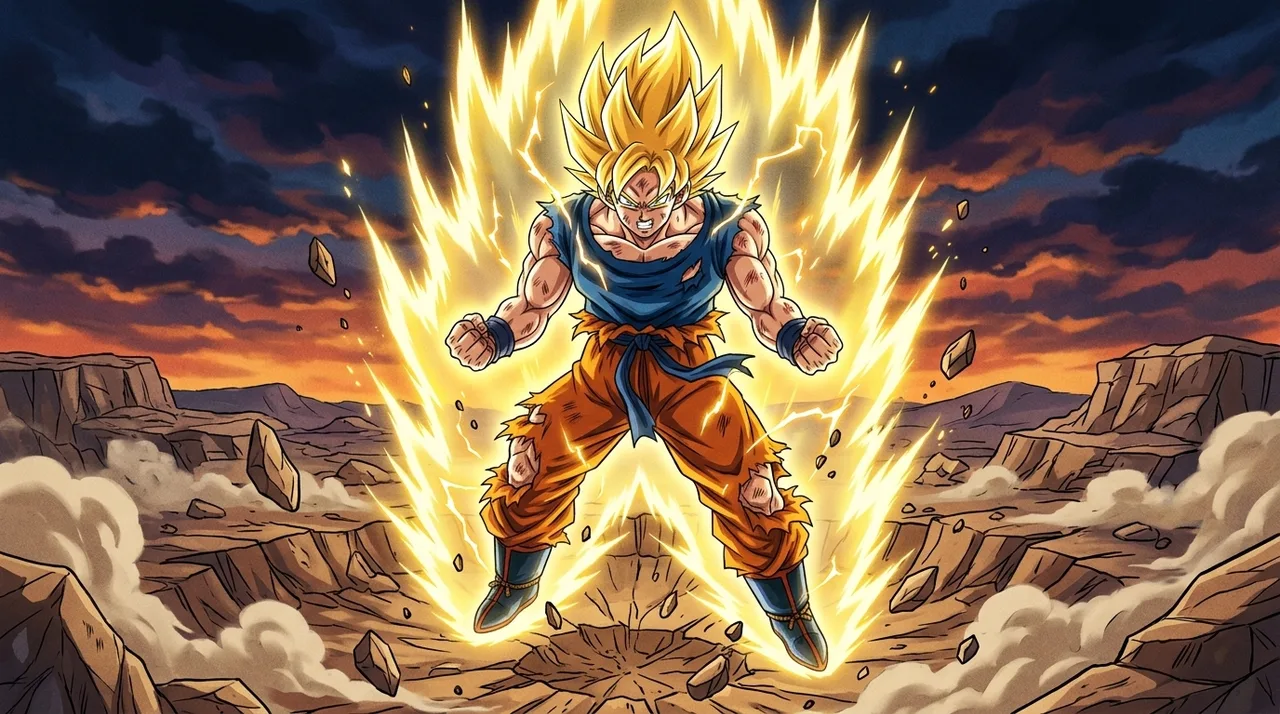
The Super Saiyan became a pop culture icon: golden hair, a flaming aura and a huge jump in power. Z also introduced Super Saiyan 2 and 3, plus fusion, from Gotenks to Vegito. Many conventions of battle shōnen, like power levels, stepped transformations and duels that last several episodes, came through here.
Our verdict is simple. The filler sometimes drags and some fights run longer than they should, but the high points of Z remain among the most powerful moments in Japanese animation. Goku's rage on Namek, Gohan against Cell, Vegeta's sacrifice against Buu: these scenes still hit, helped by Kikuchi's music. It is also the series where characters genuinely grow up, age and become parents.
Where to start
- After the original: it is the natural next step. If you skipped Dragon Ball, at least the Piccolo Junior finale will help a lot.
- Want less filler: try Dragon Ball Kai, the 2009 recut that follows the manga more closely.
- Prefer the comic: the same story is in volumes 17 to 42, covered in our Dragon Ball manga guide.
- The movies: the films of the era are side stories; our movie guide tells you which are worth it. For the full sequence see the watch order.
- After Z: continue with Dragon Ball Super, set in the ten years before the finale, or with Dragon Ball GT.
Did you know? Before Dragon Ball Z, the staff considered titles like Dragon Ball 2 and Shin Dragon Ball. It was Toriyama who suggested adding a "Z", the last letter of the alphabet, because he wanted to wrap the series up. He had no idea the sequel would run almost twice as long.