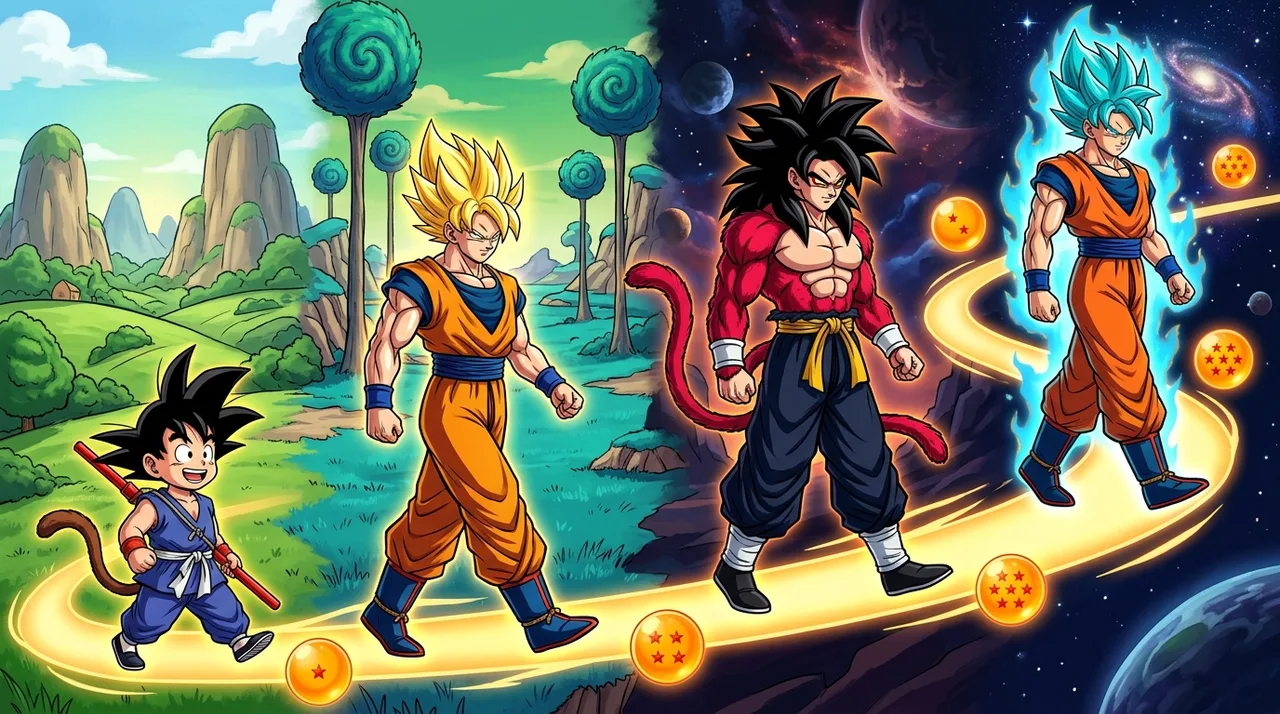
Where should you start with Dragon Ball? The short answer: with the 1986 series, then Z (or its streamlined cut, Kai), Daima, Super and the movies Broly and Super Hero. The long answer depends on what you want: to relive the saga the way fans first experienced it, to follow the story in the order it happens, or to reach the newest adventures as quickly as possible. This guide covers all three routes, with tables and a clear explanation of what counts as official story.
Before you start: what is canon
In Dragon Ball, "canon" has a specific meaning: the story told or supervised by Akira Toriyama. That includes:
- the original manga (1984–1995), adapted by the Dragon Ball and Dragon Ball Z anime, minus the filler episodes;
- the movies Battle of Gods (2013) and Resurrection 'F' (2015), both built on Toriyama's story;
- Dragon Ball Super (2015–2018), keeping in mind that the anime and Toyotarou's manga differ on a number of details;
- Dragon Ball Super: Broly (2018) and Super Hero (2022), both written by Toriyama;
- Dragon Ball Daima (2024–2025), the last story he created.
Left out are Dragon Ball GT, written by Toei Animation and effectively replaced by Super, and the Z movies of the 1990s. Those were produced at a breakneck pace for Toei's spring and summer film festivals, and they contradict each other and the series. The first three Dragon Ball movies and The Path to Power (1996) are also non-canon, since they retell the early story in alternate ways. Non-canon does not mean skippable, though: some of them are fan favorites, they just are not "the official story".
Route 1: release order
This is how audiences discovered the saga, and it has one big advantage: you see the art style evolve and understand why the 2013 comeback felt like such an event.
| Years | Title | Format |
|---|---|---|
| 1986–1989 | Dragon Ball | Series, 153 episodes |
| 1986–1988 | Three Dragon Ball movies | Movies |
| 1989–1996 | Dragon Ball Z | Series, 291 episodes |
| 1989–1995 | Thirteen Dragon Ball Z movies | Movies |
| 1990 | Bardock – The Father of Goku | TV special |
| 1993 | The History of Trunks | TV special |
| 1996 | The Path to Power | Movie for the anime's 10th anniversary |
| 1996–1997 | Dragon Ball GT | Series, 64 episodes |
| 1997 | A Hero's Legacy | GT TV special |
| 2009–2015 | Dragon Ball Z Kai | Recut of Z |
| 2013 | Battle of Gods | Movie |
| 2015 | Resurrection 'F' | Movie |
| 2015–2018 | Dragon Ball Super | Series, 131 episodes |
| 2018 | Dragon Ball Super: Broly | Movie |
| 2022 | Dragon Ball Super: Super Hero | Movie |
| 2024–2025 | Dragon Ball Daima | Series, 20 episodes |
| 2026 | Dragon Ball Super: Beerus | Enhanced edition of Super |
The only drawback is Daima: it comes last but takes place before Super, so watching it at the end feels like a step back in time. For every film in detail, see our movie guide.
Route 2: chronological story order
This route follows Goku's life from start to finish. It is the most satisfying option for anyone who has already seen the classic series and wants everything lined up.
| # | What to watch | Notes |
|---|---|---|
| 1 | Bardock – The Father of Goku | Optional: Goku's father and the end of Planet Vegeta. Broly later offers a new version |
| 2 | Dragon Ball | The whole series |
| 3 | Dragon Ball Z, Saiyans to Cell | Watch The History of Trunks during the Android saga |
| 4 | Dragon Ball Z, Majin Buu saga | Up to Buu's defeat |
| 5 | Dragon Ball Daima | Shortly after Majin Buu's defeat |
| 6 | Battle of Gods and Resurrection 'F' | Or the first arcs of Super, which remake them |
| 7 | Dragon Ball Super | From Universe 6 to the Tournament of Power |
| 8 | Dragon Ball Super: Broly | After the Tournament of Power |
| 9 | Dragon Ball Super: Super Hero | After Broly |
| 10 | The final episodes of Z | The last World Martial Arts Tournament, ten years after Buu |
| 11 | Dragon Ball GT and its special | Alternate continuity, non-canon |
Battle of Gods, Resurrection 'F' and Super
Step 6 is where most viewers get stuck. The first two arcs of Dragon Ball Super retell the stories of those two movies, with more episodes and a few changes. You do not need both: the movies are tighter and more polished, while the Super episodes are slower but give the supporting cast more room. Since 2026 there is a third option, Dragon Ball Super: Beerus, an enhanced edition of the anime that sticks closer to the manga and moves faster. It premiered in Japan on October 11, 2026, starting with the Battle of Gods arc.
What about the Z movies?
They do not really fit the plot, but if you want to slot them in, fans broadly agree on this: the Garlic Jr. movie before the Saiyans arrive; the two Cooler films, the Android 13 film and the first Broly movie during the Android and Cell period; the Bojack movie after the Cell Games; the two Broly sequels, the Janemba film and the Tapion film during the Majin Buu years. Expect the odd hiccup, like characters alive when they should be dead or transformations showing up early. Nobody designed these films to fit the continuity.
Route 3: the fast track for newcomers
Want to get to Super without hundreds of episodes in between? This is the shortest path that keeps everything essential.
| Step | What to watch | Why |
|---|---|---|
| 1 | Dragon Ball | Characters, rules and friendships are born here. There is no "short" version |
| 2 | Dragon Ball Z Kai | The story of Z in just over half the episodes |
| 3 | Dragon Ball Daima | Canon and short (20 episodes), can wait for later |
| 4 | Dragon Ball Super | Or the 2013 and 2015 movies, then Super from the Universe 6 arc |
| 5 | Broly and Super Hero | Where the animated story stands today |
Kai was made in 2009 for the twentieth anniversary of Z: Toei restored the footage, recorded new dialogue and cut nearly all the filler to follow the manga closely. English-speaking fans are lucky here, because Funimation dubbed it and it aired in the US on Nicktoons from May 2010, followed later by The Final Chapters covering the Buu saga. If you grew up with the classic Z dub, the faces are the same but the pace is completely different.
Our recommendation
For a first watch, the fast track is the best balance. For a rewatch, chronological order gives you the pleasure of seeing everything click into place, including the ten-year jump at the end of Z, which hits differently after Super. And GT? Save it for last, as a "what if": Super Saiyan 4 and that ending are worth the trip, as long as you do not try to make it fit with Super.