
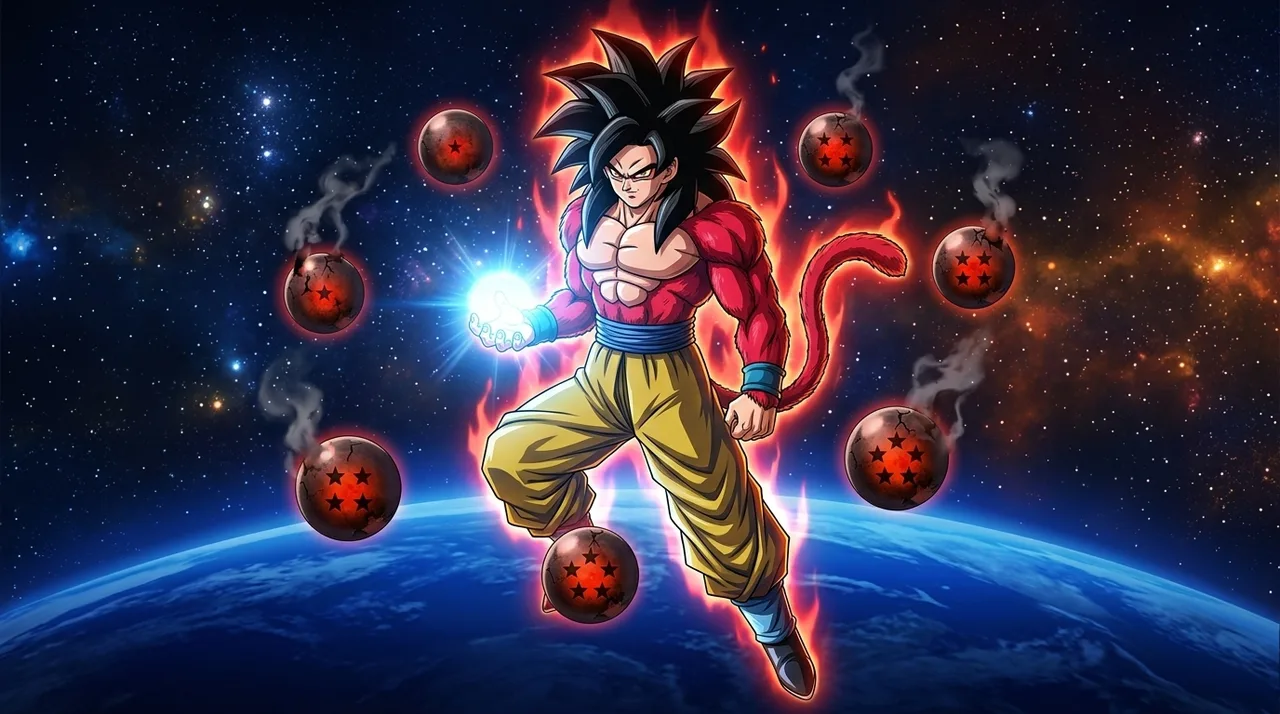
Dragon Ball GT (Grand Tour) is the sequel to Dragon Ball Z and the first series not based on the manga: the story was written by Toei Animation, while Akira Toriyama came up with the title and designed the main cast. It aired on Fuji TV from February 7, 1996 to November 19, 1997, for 64 episodes. Toriyama himself called it a "side story" of his Dragon Ball. For almost twenty years it was the last animated chapter of the saga, and it still divides fans like no other show.
Dragon Ball GT episodes
64 episodes across 4 sagas, each with a recap and our review. Open a saga or start from the very first one.
The story in brief
A botched wish by Emperor Pilaf, made with the Black Star Dragon Balls, turns Goku back into a child. The balls scatter across the galaxy, and unless they are gathered within a year, Earth will explode. Goku heads into space with Trunks and Pan, Gohan and Videl's daughter, who takes Goten's place at the last second. Along the way they meet Giru, a little robot who swallows their Dragon Radar and takes over its job.
When they return, Earth is in the hands of Baby, a Tuffle parasite who has taken over Vegeta's body to get revenge on the Saiyans. Goku beats him only after reaching Super Saiyan 4. Next comes Super 17, born from an alliance between Dr. Gero and Dr. Myuu in Hell, an arc that also brings back Frieza and Cell. In the finale, generations of selfish wishes corrupt the Dragon Balls and unleash seven Shadow Dragons: beating them takes the Super Saiyan 4 Gogeta fusion and a Spirit Bomb gathered from the whole universe. Goku leaves with Shenron, and a hundred years later an elderly Pan glimpses him, for a moment, in the crowd at a World Martial Arts Tournament.
Sagas and episode counts
| Saga | Episodes | No. | What happens |
|---|---|---|---|
| Black Star Dragon Balls | 1–16 | 16 | The space journey, in the spirit of the original Dragon Ball |
| Baby | 17–40 | 24 | The Tuffle parasite and Super Saiyan 4 |
| Super 17 | 41–47 | 7 | Dr. Gero, Dr. Myuu and the villains escaped from Hell |
| Shadow Dragons | 48–64 | 17 | Seven dragons born from the overuse of the Dragon Balls |
Main characters introduced
- Pan, Goku's granddaughter and travel companion throughout the series;
- Giru, the robot who acts as the Dragon Radar;
- Dr. Myuu, the Machine Mutant scientist of planet M-2;
- Baby, the last heir of the Tuffle race and the main arc's villain;
- Super 17, the fusion of Android 17 and his copy built in Hell;
- the Shadow Dragons, led by Syn Shenron, who becomes Omega Shenron;
- Goku Jr. and Vegeta Jr., the descendants who close the story.
Uub, the reincarnation of Majin Buu whom Goku took on as a student at the end of Z, also plays a key role in the Baby arc.
Production
The series was directed by Osamu Kasai, with series composition by Aya Matsui and Atsushi Maekawa, and character designs by Katsuyoshi Nakatsuru. The music is by Akihito Tokunaga, who took over from Shunsuke Kikuchi. The Japanese opening, used for all 64 episodes, is "Dan Dan Kokoro Hikareteku" by Field of View. The ending changes four times: "Hitori Janai" by Deen (episodes 1 to 26), "Don't You See!" by Zard (from 27), "Blue Velvet" by Shizuka Kudo (from 42) and "Sabitsuita Machine Gun de Ima o Uchinukō" by Wands (from 51). The final episode reuses the opening as an insert song.
Super Saiyan 4 was the producers' idea. Nakatsuru has said he agonized over designing it, wondering whether the transformations really needed to go any further. Since the form comes from the Great Ape state, he made the hair wilder and covered Goku's body in red fur; he considered blond hair too, but chose black for the contrast with the red.
Pan was a deliberate choice too: producer Kōzō Morishita wanted her strong but constantly in danger, a "heroine who makes Goku a hero", someone he has to rescue again and again. In 1997 Shueisha published two official guidebooks, the Dragon Ball GT Perfect Files, packed with illustrations and staff interviews; they were out of print for years before being reissued in 2006.
Dragon Ball GT in the English-speaking world
Once it finished Z in 2003, Funimation licensed GT for an English broadcast. Its dub aired on Cartoon Network's Toonami block from November 7, 2003 to April 16, 2005, with a new guitar score by Mark Menza and a rap-metal theme, "Step into the Grand Tour". The first broadcast and home release skipped the first 16 episodes and replaced them with a recap episode, "A Grand Problem"; the missing episodes aired later as "The Lost Episodes".
Canada and Europe got a different version: AB Groupe, with Blue Water Studios in Calgary, produced an alternate dub that kept Tokunaga's Japanese music and used a real child actress for Pan. Later Funimation releases also added an audio track pairing their voice cast with the original score.
Legacy and why you should watch it
GT is not considered part of the official continuity since Dragon Ball Super arrived, but its legacy is everywhere. Super Saiyan 4, with red fur, a tail and black hair, is still one of the most requested transformations in video games. And Dragon Ball Daima, created with the people who grew up on GT in mind, borrows several of its ideas: kid Goku, a journey through unknown worlds and even Super Saiyan 4.
For our team, GT is an uneven show. The first saga spins its wheels a bit, while the Baby and Shadow Dragon arcs bring strong ideas and a melancholy tone the franchise had never tried before. The finale, with Goku saying goodbye to his friends and flying off on Shenron's back, remains one of the most moving farewells in nineties animation.
Where to start
- After Z: GT picks up where Z ends, so watch it after the Majin Buu saga, and if you like, after Super.
- Short on time: you can start from episode 17 with the Baby arc, after a quick recap of the early episodes.
- The special: A Hero's Legacy (1997) follows Goku Jr. For the franchise's feature films, see our movie guide.
- The full order: between series, films and specials, our watch order shows where everything fits, and the history of Dragon Ball explains how the franchise got to GT.
Did you know? "GT" stands for Grand Tour: Toriyama picked the title himself, inspired by the journey across the universe in search of the Dragon Balls that opens the series.