The Other World Tournament Saga is the shortest detour in Dragon Ball Z: five episodes, 195 to 199, broadcast on Fuji TV between July 28 and September 1, 1993. It was created entirely for the anime and shows how Goku spends his time after death: a tournament among the greatest deceased fighters of the four galaxies, with a new rival, Pikkon, and a prize nobody manages to win.
Where it fits
It picks up right after the Cell Games. Goku sacrificed himself to stop Cell's self-destruction and chose to stay in the afterlife, convinced Earth was safer without him, since so many enemies had come looking for him. At this point Toriyama's manga simply jumps ahead seven years. As usual when a weekly show is chasing a weekly comic, Toei filled the gap with an original interlude: it gave the manga room to move ahead and fleshed out Other World along the way.
In Funimation's early home video releases these episodes were folded into the Great Saiyaman Saga; the dub premiered on Cartoon Network from September 10 to 14, 2001. Later Funimation season sets open season seven with them. Dragon Ball Kai, which cuts all anime-only material, skips the arc entirely. In Japan, these are the last episodes to use Cha-La Head-Cha-La as the opening.
The Grand Kai and the four Kais
The arc expands the map of the afterlife. King Kai, killed in Cell's explosion and now sporting a halo, explains to Goku that each galaxy, North, South, East and West, has its own Kai, and that above them all sits the Grand Kai. His planet, reached by plane from King Yemma's check-in station, is home to the most righteous warriors, who are allowed to keep their bodies so they can go on training.
The Grand Kai is a casually dressed old man with a boombox and a cigarette who turns out to be blindingly fast but, deep down, a bit lazy. Around him, the four Kais behave like rival coaches: West Kai is King Kai's sworn competitor, while East Kai, the only woman among them, is obsessed with racing and tough on her athletes.
Hell: Cell, Frieza and company
In episode 195 the Grand Kai asks for help: in Hell, a freshly arrived Cell has teamed up with Frieza, King Cold and four members of the Ginyu Force, and they are tormenting the ogre guards. Goku handles the Ginyu Force, but it is Pikkon who settles things, dropping Cell and Frieza with one blow each. It is a perfect introduction for the newcomer, and the only time Goku ever comes face to face with King Cold.
Pikkon, Goku's rival in Other World
Champion of the West Galaxy (Paikuhan in Japanese), Pikkon is a quiet, honorable fighter voiced in Japan by Hikaru Midorikawa and in Funimation's dub by Kyle Hebert. His Japanese name is a pun on pork ribs with rice. Japanese guidebooks call him a "Piccolo-type character," and sure enough he fights in a turban and weighted clothes, just like Piccolo did against Raditz.
The tournament, round by round
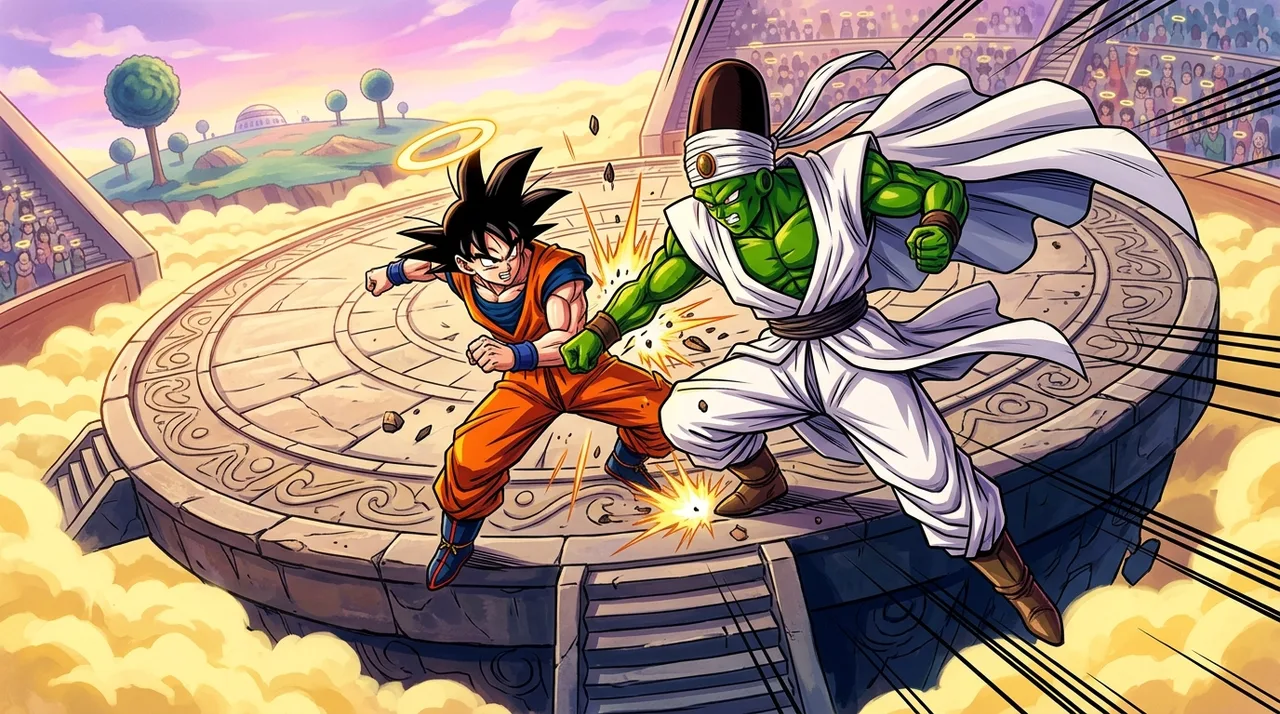
The idea comes from West Kai, as a way to "celebrate" King Kai's death; the prize is training with the Grand Kai. Goku, the new arrival, has to earn his spot in a race against East Kai. In the first round he beats Caterpy, a caterpillar who fights by tickling and retreats into a cocoon for a 1,200-year metamorphosis. In the quarterfinals he gets past Arqua, who turns the ring into a cube of water, while Pikkon eliminates Olibu, a legendary hero of Earth. In the semifinals Goku throws out Maraikoh, who can turn invisible.
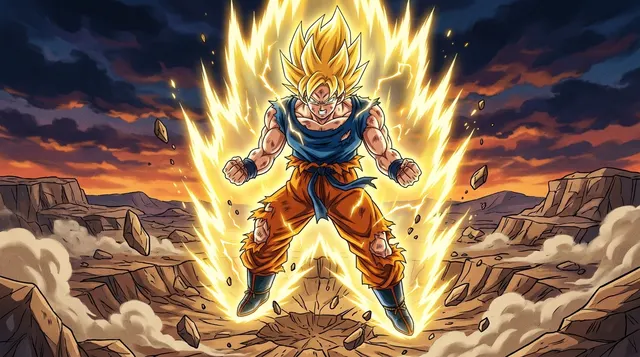
The final is the highlight: Pikkon sheds his weights, Goku goes Super Saiyan and even brings back the Kaio-ken; Pikkon answers with his Hyper Tornado and Thunder Flash, until Goku beats him with Instant Transmission and a Kamehameha. But the Grand Kai disqualifies them both for touching the arena's ceiling and puts off their training by two or three centuries.
Main characters in this saga
Episodes
| No. | Funimation title | First aired (Japan) | Notes |
|---|---|---|---|
| 195 | Warriors of the Dead | July 28, 1993 | Pikkon vs. Cell and Frieza in Hell |
| 196 | Tournament Begins | August 11, 1993 | the race and the first round |
| 197 | Water Fight | August 18, 1993 | Goku vs. Arqua, Pikkon vs. Olibu |
| 198 | Final Round | August 25, 1993 | the final begins, Goku goes Super Saiyan |
| 199 | Goku vs. Pikkon | September 1, 1993 | the disqualification; Gohan starts school |
All five episodes are filler. The last minutes of 199, with the seven-year jump and Gohan setting off on the Flying Nimbus, already work as a prologue to the next arc.
Filler and links to other works
Pikkon turned out to be one of the luckiest anime-only characters in the franchise. At the end of Bio-Broly (1994) Goku mentions him; in Fusion Reborn (1995) the two meet again in the final of a new Other World Tournament, which the demon Janemba interrupts, and Pikkon plays a key supporting role. He also shows up in anime-only scenes in episodes 278 and 279, near the end of the Majin Buu arc.
The tournament also made its way into video games: in Budokai Tenkaichi 3 it is one of the available tournaments, with Pikkon as a possible final opponent, and Buu's Fury has Goku take part in it.
Our take
The Other World Tournament changes nothing in the story, and it does not pretend to. It is a vacation: after the tension of the Cell Games, the anime treats itself to a sports comedy with betting Kais, a tickling caterpillar and a referee who wins the footrace. The tone recalls the early tournaments of Dragon Ball, when Goku fought purely for the joy of testing himself.
That is exactly where its value lies. Watching Goku happy in death, facing bizarre opponents and an honorable rival like Pikkon, makes his choice not to come back easier to accept, and the final holds up well next to many of the manga's fights. Five unpretentious episodes, but among the most enjoyable filler in Dragon Ball Z.
Up next: the Majin Buu Saga, episodes 200-291 →
 Series guideDragon Ball Z: guide to sagas, characters and triviaPlot, characters, production and theme songs: the full picture of Dragon Ball Z, worth reading before or after the episodes.Read the guide →