
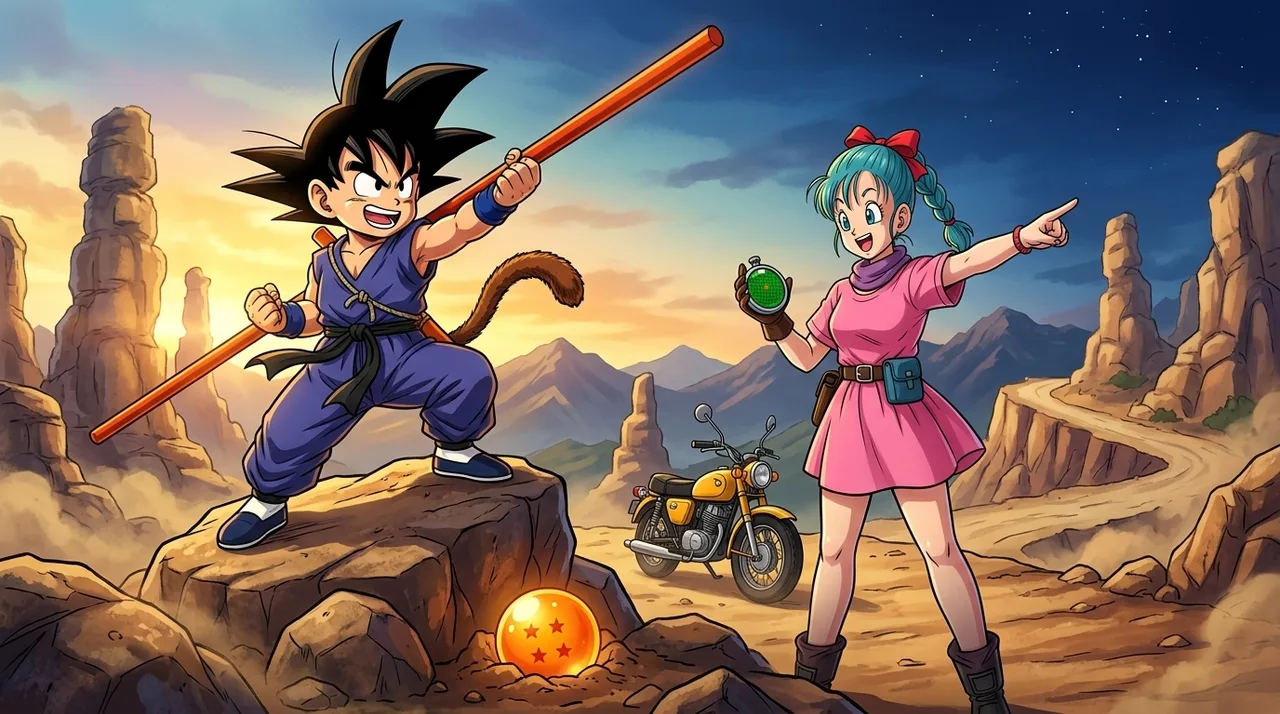
Dragon Ball is the anime where it all began. Produced by Toei Animation and broadcast in Japan by Fuji TV from February 26, 1986 to April 19, 1989, it runs for 153 episodes and adapts the first part of Akira Toriyama's manga, serialized in Weekly Shōnen Jump from 1984. It covers the first 17 volumes of the comic, from the moment Goku meets Bulma to the final of the 23rd World Martial Arts Tournament. It is the lightest, most adventurous entry in the franchise, and the one that lays down every rule, location and friendship the later shows take for granted.
Dragon Ball episodes
153 episodes across 7 sagas, each with a recap and our review. Open a saga or start from the very first one.
The story in brief
Son Goku is a monkey-tailed boy with absurd strength who lives alone in the mountains. When he meets Bulma, a teenage inventor hunting for the seven Dragon Balls that summon the dragon Shenron and grant a wish, he is pulled into a journey that soon turns into a martial arts epic. The stated inspiration is the Chinese classic Journey to the West, with Goku as a modern take on the Monkey King, Sun Wukong.
After the first hunt for the Dragon Balls, contested by the tiny would-be tyrant Emperor Pilaf, Goku trains under Master Roshi alongside Krillin, a rival who quickly becomes his best friend, to compete in the World Martial Arts Tournament. He then sets out alone to recover his late grandfather's four-star ball and ends up dismantling the Red Ribbon Army almost single-handedly, feared assassin Mercenary Tao included.
The second half changes tone. The next tournament brings in Tien Shinhan and Chiaotzu, students of the Crane Hermit, and right after it comes King Piccolo: the series' first truly ruthless villain, who kills Krillin and Master Roshi. Goku defeats him, but before dying the demon spawns a son. Three years later, after training with Kami, a now-adult Goku faces Piccolo Junior in the final of the 23rd tournament, wins by a hair and keeps his promise to marry Chi-Chi.
Sagas and episode counts
Toei never officially split the show into sagas. The division everyone uses comes from Funimation's home video releases and is also the one adopted by Wikipedia. Here it is, with the episodes in each block.
| Saga | Episodes | No. | What happens |
|---|---|---|---|
| Emperor Pilaf | 1–13 | 13 | The first Dragon Ball hunt, with Oolong, Yamcha and Puar |
| Tournament | 14–28 | 15 | Training with Roshi and the 21st tournament |
| Red Ribbon Army | 29–45 | 17 | Goku against the army's first bases |
| General Blue | 46–57 | 12 | Pirate treasure and a detour to Penguin Village |
| Commander Red | 58–68 | 11 | Mercenary Tao, Korin Tower and the army's fall |
| Fortuneteller Baba | 69–83 | 15 | Baba's fighters and the last Dragon Ball |
| Tien Shinhan | 84–101 | 18 | The 22nd World Martial Arts Tournament |
| King Piccolo | 102–122 | 21 | Krillin's death and the fight against the demon |
| Piccolo Jr. | 123–153 | 31 | Training with Kami and the 23rd tournament |
If you want an episode-by-episode breakdown, start with our guide to the Emperor Pilaf Saga.
Main characters introduced
Almost the entire classic cast debuts here:
- Goku, naive, always hungry and incredibly strong, still unaware that he is a Saiyan;
- Bulma, the brilliant inventor who sets the first adventure in motion;
- Krillin, Goku's training partner and first real friend;
- Master Roshi, the Turtle Hermit who created the Kamehameha;
- Yamcha, Oolong and Puar, the first travel companions;
- Chi-Chi, daughter of the Ox-King and Goku's future wife;
- Tien Shinhan and Chiaotzu, rivals turned allies;
- Yajirobe, Korin and Kami, key figures in the second half;
- Piccolo, first as the demon king and then as his son, the enemy who becomes one of the heroes in Z.
Production
The series was directed by Minoru Okazaki and Daisuke Nishio, with character designs by Minoru Maeda and scripts by a team that included Takao Koyama. The score is by Shunsuke Kikuchi, who would also compose for Z. The Japanese opening, used for all 153 episodes, is "Makafushigi Adventure!" by Hiroki Takahashi; the ending is "Romantic Ageru yo" by Ushio Hashimoto.
Toriyama was more involved than people often assume. Early on he told the staff they were making the show too colorful by carrying over the palette of Dr. Slump. He also listened to the audition tapes for Goku and picked Masako Nozawa, who still voices the character today. His editor Kazuhiko Torishima, unhappy with the Dr. Slump anime, had Shueisha follow production closely. When ratings started to slip, he asked Toei to change producers and brought in director Kōzō Morishita and writer Takao Koyama: that "reboot" became Dragon Ball Z.
As was common at the time, many episodes add material that is not in the manga. Episodes 55 to 57, for instance, are a crossover with Dr. Slump featuring Arale.
Dragon Ball around the world
The road to English-speaking audiences was bumpy. In 1989 and 1990 Harmony Gold produced a short-lived dub that renamed almost everyone, Goku included, who became "Zero". In 1995 Funimation licensed the series as one of its first imports and had thirteen edited episodes dubbed in Vancouver; they aired in syndication that fall but low ratings stopped the project, and the company moved on to Z.
The success of Dragon Ball Z brought the original back. Funimation recorded a new in-house dub, with lighter editing and the Japanese background music left intact, which aired on Cartoon Network from August 20, 2001 to December 1, 2003. In Canada and Europe an alternative English version produced by AB Groupe with Blue Water Studios aired instead. Elsewhere the show had long been a hit: in Italy it debuted in 1989, and in Spain regional channels made it a phenomenon from 1990 onward.
Legacy and why you should watch it
Plenty of Western fans met the franchise through Z and skipped this one, which is a real shame. The original moves at a different pace: more road trip than slugfest, more gags than screaming, with a sense of adventure straight out of the kung fu films Toriyama loved. It is also the show that builds the relationships. Without the rivalry with Krillin, Roshi's lessons and genuine fear in the face of King Piccolo, the drama in Z lands much softer.
For our team it is the most rewatchable part of the franchise. Episodes work on their own, the cast is irresistible, and Goku's growth from wild kid to young man getting married at the tournament grounds is the best coming-of-age story the saga has ever told. It is no coincidence that, forty years later, Dragon Ball Daima set out to recapture exactly this spirit.
Where to start
- First taste: watch the first 28 episodes, the Emperor Pilaf and Tournament sagas. If they hook you, the rest follows naturally.
- Short on time: focus on the tournaments and the King Piccolo arc, though you will lose many side characters.
- The manga: if you prefer paper, the first 17 volumes tell the same story without the anime additions; see our Dragon Ball manga guide.
- Next: move on to Dragon Ball Z. For the full sequence, movies included, check our watch order, while the history of Dragon Ball tells the story of the franchise from the start.
Did you know? While the series was on the air, Toei released three Dragon Ball films between 1986 and 1988. A fourth, The Path to Power, followed in 1996 for the anime's tenth anniversary: you will find them all in our movie guide.