
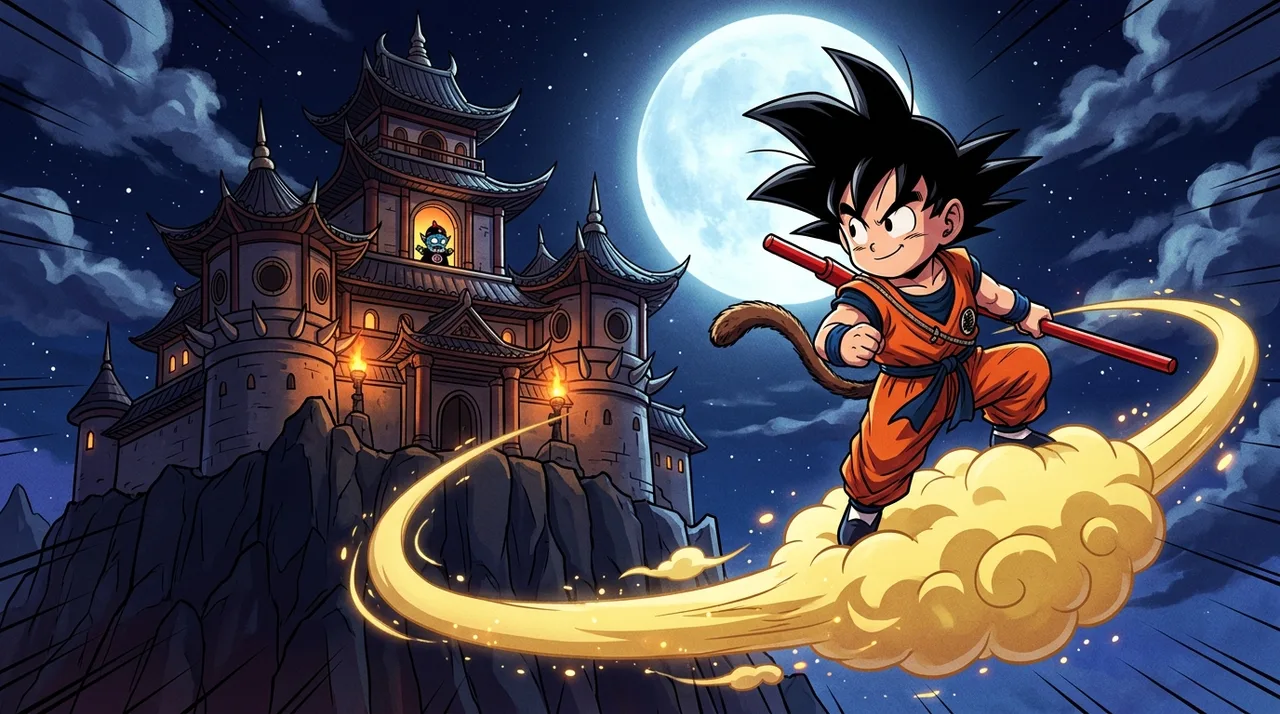
The Emperor Pilaf Saga is the opening arc of Dragon Ball: thirteen episodes that aired on Fuji TV between February 26 and May 21, 1986, adapting the first 23 chapters of Akira Toriyama's manga. It covers the very first Dragon Ball hunt, from the day Goku meets Bulma to a full-moon night inside Pilaf's castle, and it introduces almost every character the franchise would lean on for decades.
What the saga is about
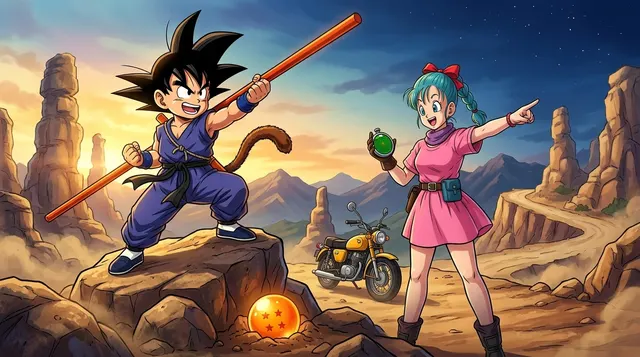
Goku is a monkey-tailed boy living alone in the mountains, with only a four-star ball left by his adoptive grandfather for company. Bulma is a brilliant, spoiled city girl who has found the legend of the seven Dragon Balls: gather them all and the dragon Shenron grants a wish. She already owns two, plus a radar she built herself, and she knows exactly what she wants: the perfect boyfriend.
That meeting kicks off a road trip told in stops. Each episode brings a new place, a new obstacle and often a new travelling companion: a lost sea turtle, a village terrorized by a shapeshifter, a desert bandit, a mountain on fire, a town bullied by a giant rabbit. In the background, the tiny Emperor Pilaf schemes to collect the balls and rule the world. When he finally gets his chance, his wish is hijacked in the silliest way imaginable, and the saga ends by revealing Goku's darkest secret: under a full moon he becomes a giant ape.
Characters introduced
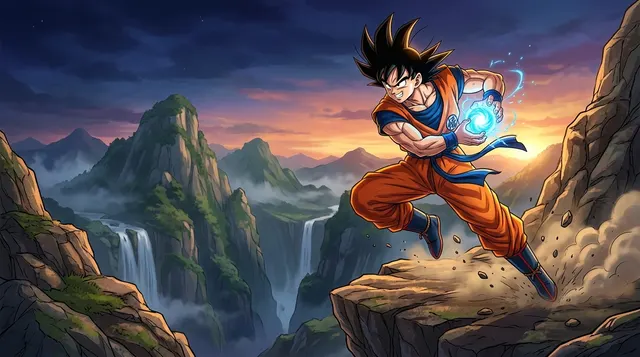
- Goku: absurdly strong, naive and raised far from civilization. He has never seen a car or a girl, and meets every new thing with the same cheerful curiosity.
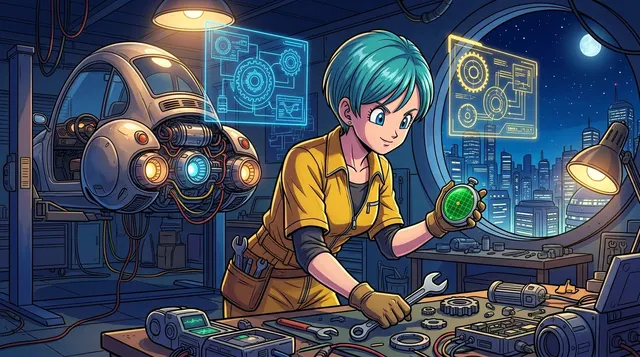
- Bulma: inventor of the Dragon Radar and the brains of the group. Her temper drives most of the comedy.
- Oolong: a shapeshifting pig who has been kidnapping girls from a village. His transformations last only five minutes. After Goku beats him, Bulma drafts him into the quest against his will.
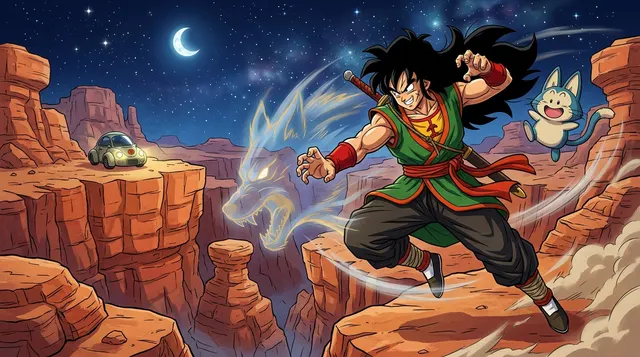
- Yamcha and Puar: a desert bandit who fights brilliantly but freezes up around girls, and his small flying, shapeshifting partner, who went to the same shapeshifting school as Oolong.
- Master Roshi: the Turtle Hermit, a lecherous old recluse who gives Goku the Flying Nimbus and later shows the world the Kamehameha.
- Chi-Chi and the Ox-King: a fierce little girl and her giant father, whose castle sits on top of a mountain that has been burning for years. The Ox-King trained under Roshi alongside Goku's grandfather.
- Emperor Pilaf, Mai and Shu: a pint-sized would-be conqueror and his two henchmen, a gun-toting woman and a dog-like ninja. More bumbling than threatening.
- Shenron: the Eternal Dragon, who only appears in full near the end.
Main characters in this saga
Episode list
| No. | English title | First aired (Japan) |
|---|---|---|
| 1 | Bulma and Son Goku | February 26, 1986 |
| 2 | The Emperor's Quest | March 5, 1986 |
| 3 | The Turtle Hermit's Kinto-Un | March 12, 1986 |
| 4 | Oolong, the Kidnapping Monster | March 19, 1986 |
| 5 | Yamcha, The Strong Yet Cruel Desert Bandit | March 26, 1986 |
| 6 | Midnight Callers | April 2, 1986 |
| 7 | Gyumao of Mt. Frypan | April 9, 1986 |
| 8 | The Turtle Hermit's Kamehameha | April 16, 1986 |
| 9 | The Rabbit Boss' Special Technique | April 23, 1986 |
| 10 | The Dragon Balls are Stolen!!! | April 30, 1986 |
| 11 | At Last the Dragon Appears! | May 7, 1986 |
| 12 | The Wish to Shen Long | May 14, 1986 |
| 13 | Goku's Great Transformation | May 21, 1986 |
We use the translated Japanese titles. Funimation's dub went with its own names, starting with "The Secret of the Dragon Balls" for episode 1 and ending with "The Legend of Goku" for episode 13.
Anime vs. manga
The anime follows the manga closely, with one big structural change: Pilaf shows up much earlier. In the comic, the emperor and his henchmen only enter the story after the Rabbit Boss chapter, when the hunt is almost over. In the TV series Pilaf finds his first Dragon Ball in episode 1, and Mai and Shu keep turning up to get in the way: in a valley full of wolves, ransacking Roshi's house, planting a bomb under Oolong's camper. Those additions turn a string of mostly self-contained adventures into a race against a clear rival.
Other additions are smaller: Goku's escape from a sabertooth tiger in episode 1, a proper fight between Goku and the Ox-King, the chase through Pilaf's castle with giant pinballs. The source material still dominates, though. Thirteen episodes cover twenty-three chapters, close to two chapters per episode, which leaves little room for the padding that would weigh down later series.
Our take
The Pilaf Saga is the Dragon Ball closest to the gag-comic roots of Toriyama, the creator of Dr. Slump. There is fighting, but mostly to show who Goku is: a kid who wins without effort or malice. The real engine is the culture clash between a wild boy and a city girl, joined one by one by a cowardly pig, a shy bandit and a dirty old master. It is a band of lovable losers, and the arc moves with the light step of a serialized adventure novel.
Some of the humor is very risqué and has aged badly. Funimation's 1995 dub cut several scenes, and the 1996 Italian edition toned down much of the suggestive dialogue as well. First-time viewers should expect a few gags that have not survived the decades.
What holds up beautifully is the world-building. Capsules that pop out houses and motorcycles, a radar for the balls, a cloud only the pure of heart can ride: in thirteen episodes the show sets rules it will use forever, including the fact that the balls scatter after a wish and stay inert for a year. And the ending, with what it reveals about the death of Goku's grandfather, shows for the first time that there is a dark side under the comedy. It is the right place to start if you want to understand where everything else came from.
Up next: the 21st World Martial Arts Tournament saga (episodes 14-28) →
 Series guideDragon Ball (1986): complete guide to the original seriesPlot, characters, production and theme songs: the full picture of Dragon Ball, worth reading before or after the episodes.Read the guide →