
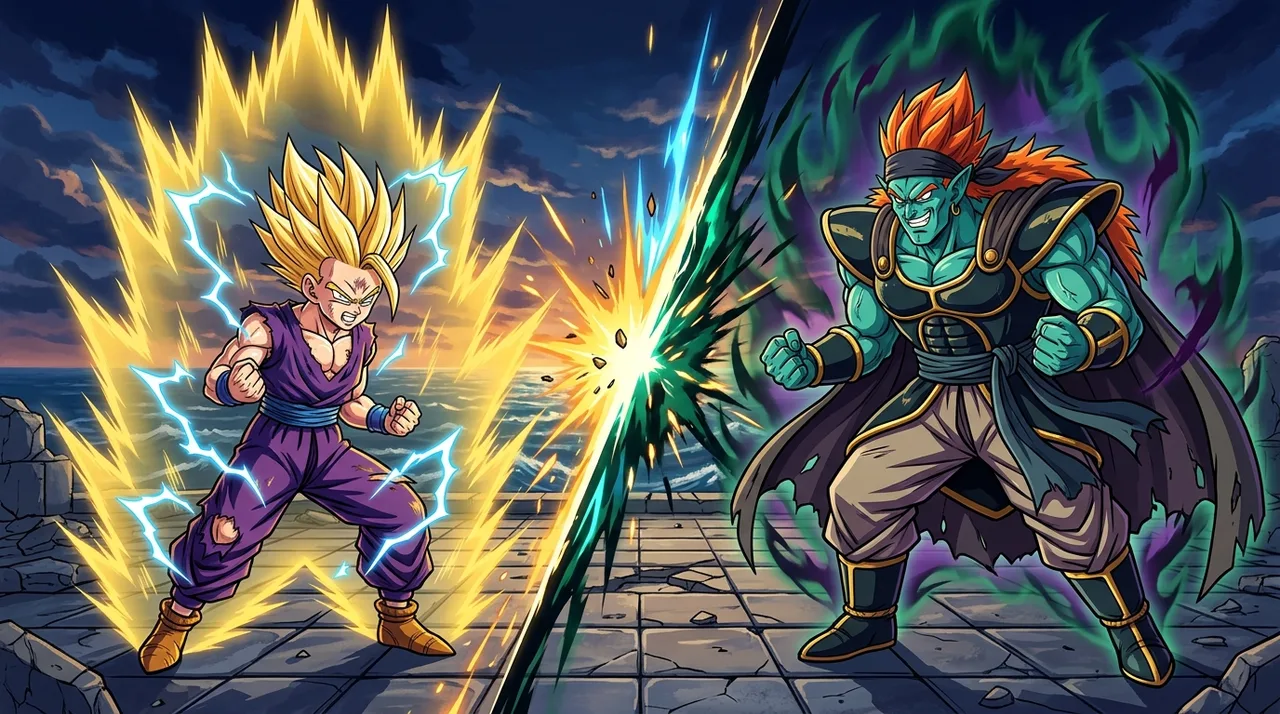
Dragon Ball Z: Super Butōden 2 is the second Dragon Ball fighting game for the Super Nintendo, developed by Tose and published by Bandai. It came out in Japan on December 17, 1993, nine months after the first entry, and in 1994 in France and Spain as Dragon Ball Z: La Légende Saien. Many fans consider it the best Dragon Ball game of the 16-bit era: the one that took its predecessor's good ideas and made them genuinely fun.
How it plays
Like the first Super Butōden, it is a one-on-one fighter in the vein of Street Fighter II: drain your opponent's health bar to win. The controls use six customizable buttons, with L and R to dash forward and back and the option to charge ki for energy blasts. Special moves use classic button combinations.
Its most famous trick is still the split screen: when the fighters drift apart, the view splits in two to keep both on screen, while an improved radar tracks their positions. The sequel adds three things:
- Water stages and more varied arenas;
- Counters to special moves: an energy blast can be deflected or cancelled, turning every Kamehameha into a gamble;
- Meteor combos: chains of consecutive attacks for nearly every character, whereas in the first game only Goku had one.
Characters and story
The roster has ten fighters: Gohan, Vegeta, Trunks, Piccolo, Cell, Cell Jr., Bojack, Zangya and, unlockable with a code, Goku and Broly. Story mode starts at the Cell Games and continues with an original tale that blends events from the Broly and Bojack movies, with Gohan in the lead. There is also a versus mode, against the computer or a friend, and a tournament for up to eight entrants.
The character choices have a simple explanation. When the game came out, the Dragon Ball Z manga had only just entered the Majin Buu arc and nobody knew what the new villain would look like yet. So the team turned to the two movies released in 1993, adding Broly and Bojack in just a few months of work.
Development
The sequel was made almost entirely by the first game's team, led by producer Toshihiro Suzuki and director Shinsaku Shimada. According to Suzuki, work began right after the first game was finished, following a one-week break. The goals were clear: more stages, adventure elements in the tournament mode and characters from the movies. The underwater stage was commissioned from Toei Animation, while the music was composed by a team that included Kenji Yamamoto.
Reception
In Japan it topped the Famitsu sales chart in December 1993 and sold between 1.15 and 1.2 million copies at home alone. The European press loved it: 93% in France's Joypad, 93/100 in Superjuegos and 92/100 in Nintendo Acción in Spain, which praised its visuals, speed and counters. Some magazines, such as the UK's Super Play, found it too similar to the first game. The third entry, Super Butōden 3, followed in 1994.
Did you know? In France, at launch, the La Légende Saien cartridge came bundled with the first volume of the Dragon Ball manga. The title, with "Saien" instead of "Saiyan", reflects how unsettled the spelling of Goku's race still was back then.
Re-releases
The game never had an official North American release until 2015, when the Japanese version was offered as a pre-order bonus for Dragon Ball Z: Extreme Butōden on Nintendo 3DS through select retailers in the UK and the US. Three years later the first Super Butōden got the same treatment, as a pre-order bonus for FighterZ on Switch.
Our take
Super Butōden 2 is the bridge between Dragon Ball on TV and Dragon Ball in games: with a handful of sprites and a split screen, Tose managed to convey distance, speed and the weight of energy attacks. Its rules are simple and it shows its age in places, but duels against a friend still work. If you like its spirit, its modern 2D heir is Dragon Ball FighterZ; meanwhile it sits seventh in our ranking of the best Dragon Ball games.