
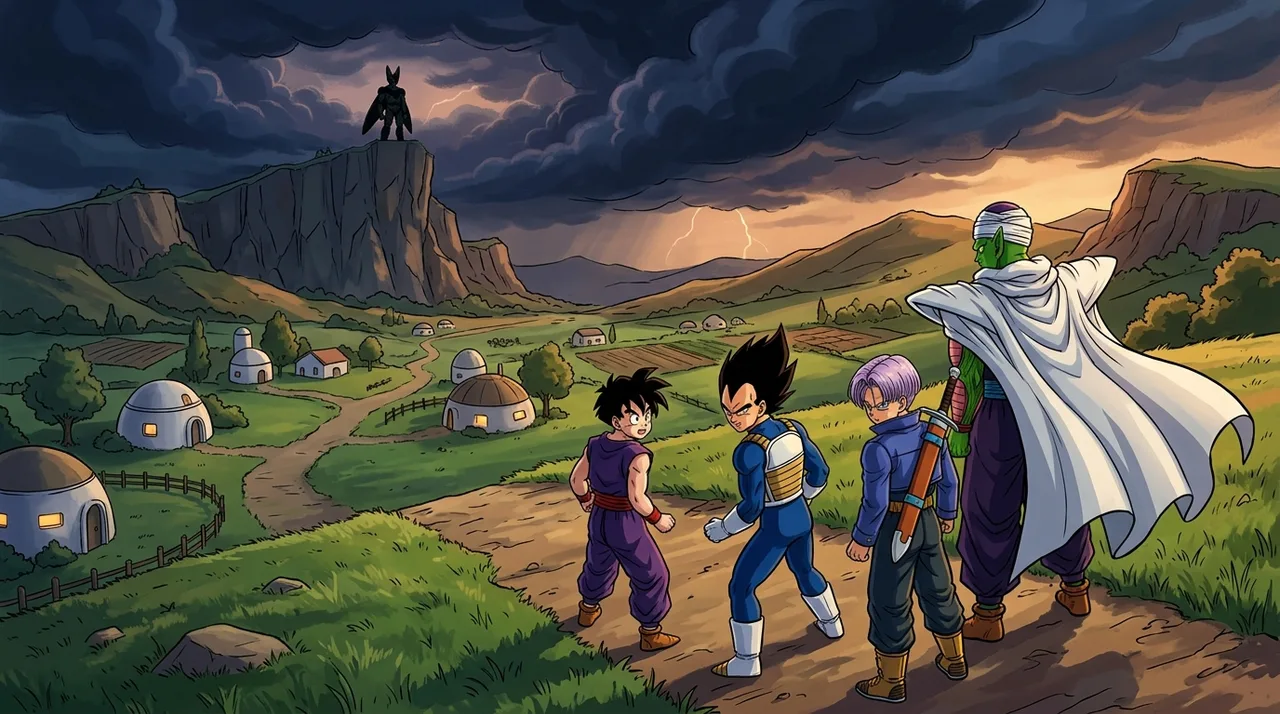
Dragon Ball Z: The Legacy of Goku II is a Game Boy Advance action RPG developed by American studio Webfoot Technologies and published by Atari. It came out on June 17, 2003 in North America and in August in Europe. A sequel to the first The Legacy of Goku (2002), it fixes nearly everything that game got wrong and covers the Android and Cell sagas with an explorable map, side quests and experience levels: a small RPG that is still a pleasure to play today.
The story
The game opens in the alternate future of the TV special The History of Trunks: Goku has died of a heart disease, two androids have wiped out the Z Fighters and most of humanity, and only Gohan and young Trunks are left. When Gohan falls too, Trunks climbs into the time machine. In the present he arrives just in time to stop Frieza and King Cold, who have landed on Earth seeking revenge, and to warn Goku of what is coming.
From there the plot faithfully follows the main events: Androids 19 and 20, then Android 17 and Android 18, the arrival of Cell, the Hyperbolic Time Chamber and the Cell Games, all the way to Gohan's victory. There are detours into the movies too, such as a fight with Cooler, Frieza's brother.
How it plays
The view is top-down, like the classic handheld action RPGs. You fight in real time with physical blows and ki attacks, earn experience and level up (to a cap of 50), and pick up capsules around the world that raise your stats. Compared with the first game, there is a lot that is new:
- Five playable characters: you start as Gohan and gradually unlock Piccolo, Vegeta, Trunks and finally Goku, swapping between them at Capsule Corporation points;
- Transformations: Super Saiyan for the four Saiyans and Super Namekian for Piccolo, stronger but with a steady energy drain;
- Scouter: shows a detailed map of the area and the stats of characters on screen;
- Charged attacks: a powerful physical strike after a short wind-up.
Oddly, free flight is gone: you move between zones via flight pads or the world map, which also lets you return to areas you have already visited. The soundtrack follows the style of Bruce Faulconer's score for FUNimation's English dub.
Despite the title, Goku is the character you use least: he joins late and is no longer available once the story ends. Keep playing with the others and you can unlock Mr. Satan (Hercule), who opens an alternate ending.
Did you know? It is the only Dragon Ball Z game developed in the United States to be released in Japan: Banpresto published it on July 23, 2004 as The Legacy of Goku II International, with new character portraits and the original Japanese names in place of the American ones.
Reception and sales
Critics liked it (75 on Metacritic): IGN gave it an 8 and especially praised the ability to switch characters, while GameSpot scored it 7.6. Tougher outlets such as Electronic Gaming Monthly and Game Informer criticized the combat system and the need to grind levels by fighting endless animals and minor enemies. Sales were strong: in the United States it passed 630,000 copies by August 2006, ranking among the best-selling GBA games of that period. Its success led to a third chapter, Buu's Fury, in 2004.
Who it is for
Fans of old-school action RPGs who want to relive the Cell saga through the eyes of Gohan, the real lead of this era. Today you will need an original cartridge. If you want the same idea in modern form, a Dragon Ball Z story to explore and not just fight through, look at Dragon Ball Z: Kakarot.
Our take
Legacy of Goku II proves that a small Western studio could understand Dragon Ball better than many official adaptations. It lacks the spectacle of the fighting games, but it offers something rarer: the feeling of living inside the series, chatting with characters and roaming the world between fights. That is why it sits eighth in our ranking of the best Dragon Ball games.