
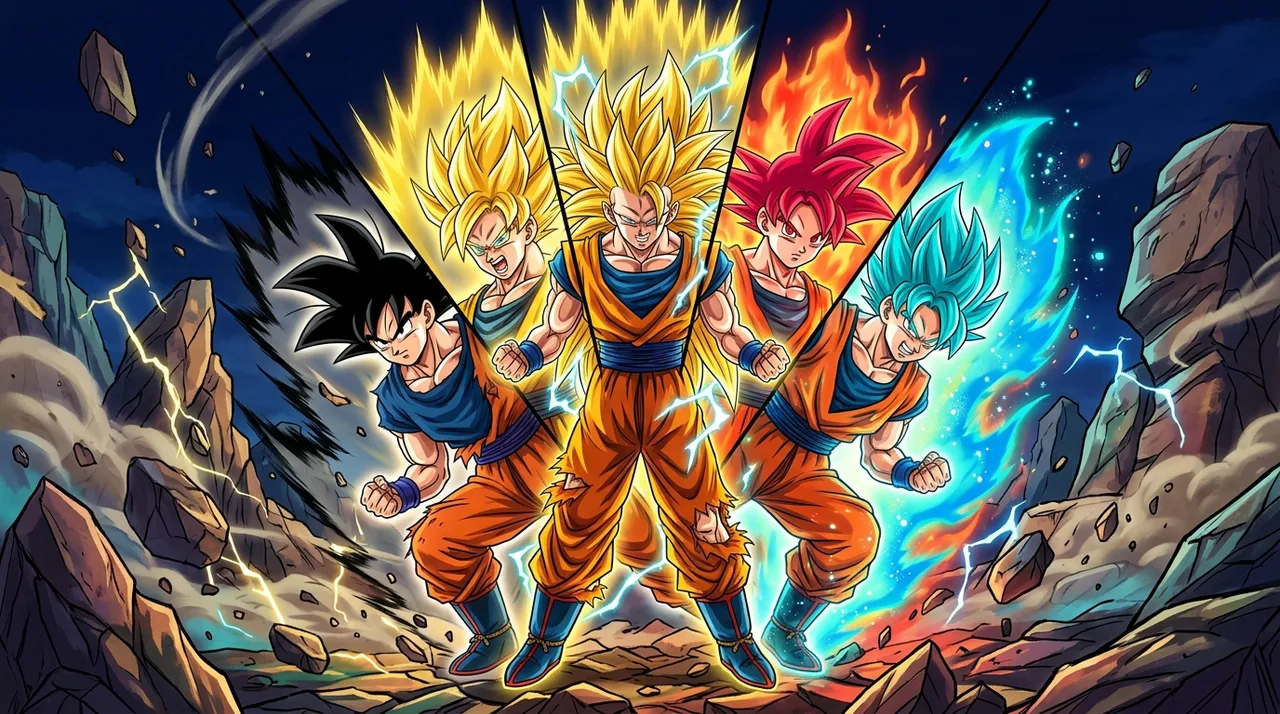
In Dragon Ball, a transformation is the most direct way to show a character breaking a limit. Super Saiyan debuted in chapter 317 of the manga in 1991, when Goku faces Frieza on Namek after watching him kill Krillin: golden hair, an icy stare and a rage he can barely keep in check. From then on, every major arc has brought a new form. Here is how we got here, in order and with the stories behind each one.
The Great Ape, the original form
Before the golden hair came the Oozaru, the Great Ape. A Saiyan with a tail who looks at the full moon turns into a giant ape, incredibly strong and almost always out of control. Goku first transforms back in chapters 21 and 22 in 1985, wrecking Pilaf's castle without realizing it, and he is only stopped when his tail is cut off. Later Vegeta shows that a trained Saiyan can create an artificial moon and keep his wits in that form. For years the Great Ape was mostly a family secret, and a clue to the hero's alien roots.
Super Saiyan: a legend comes true
In Saiyan lore, the Super Saiyan is a warrior who appears once every thousand years, and it is exactly that legend that frightens Frieza. Goku fulfills it at his lowest moment, and the transformation symbolically closes the arc: for the first time, the invincible villain is afraid.
The real-world reason is far more down to earth. In the book released for the series' 30th anniversary, Toriyama explained that he made Goku's hair blond to save his assistant work, since the assistant spent a lot of time blacking in the hero's hair. In 2018 Hiroyuki Nakano, then editor-in-chief of Weekly Shōnen Jump, repeated the story on Japanese TV: in a black-and-white manuscript, blond hair can simply be left white. The popular version says it was "to save ink", but what really mattered was time, which is precious when you publish every week. The stare, on the other hand, comes from Bruce Lee: Toriyama wanted to capture that paralyzing glare.
While training for Cell, Vegeta and Trunks try to push the form with extra muscle, while Goku and Gohan take the opposite route, staying transformed day and night until the form feels natural.
Super Saiyan 2 and 3
The second level appears in chapter 409, when Gohan explodes with rage against Cell: spikier hair and electricity crackling in his aura. The name "Super Saiyan 2" only arrives later, in chapter 474, when Goku shows Majin Buu each stage to buy time and caps it with Super Saiyan 3: extremely long hair, no eyebrows and a huge energy drain, which eats into the precious time of a Goku who has only temporarily returned from the afterlife. The anime version, episode 245, aired on November 9, 1994.
Super Saiyan 4: from GT to Daima
In Dragon Ball GT, the fourth form grows out of the Great Ape: Goku becomes a Golden Great Ape, regains control and turns Super Saiyan 4, with red fur, black hair and a tail. Its full debut is in episode 35, aired in late January 1997, and the design is not Toriyama's but character designer Katsuyoshi Nakatsuru's.
Almost thirty years later, Dragon Ball Daima brings it back into the story written by Toriyama: in episode 18 Goku becomes a Super Saiyan 4 with a boost of energy from the Namekian Neva, and in the finale he reveals he had already reached it while training after the Buu arc. In Daima Vegeta also shows off Super Saiyan 3, which his pride would rather call by another name.
The divine forms: God and Blue
The film Battle of Gods (2013) introduces Super Saiyan God: five pure-hearted Saiyans pour their energy into a sixth, and Goku gains red hair and a divine aura. Two years later, Resurrection 'F' (2015) brings Super Saiyan God Super Saiyan, renamed Blue because the original name was a mouthful even for the characters. Why blue? Toriyama answered with disarming honesty: the previous film was red, so this one would be blue. He had also considered white, but it would have clashed with the "next enemy".
Ultra Instinct and Ultra Ego
Ultra Instinct is not a Super Saiyan level but a state in which the body fights on its own, without going through conscious thought. Toriyama supplied its name, backstory and design to Toei's staff during the Tournament of Power: the incomplete version debuts in episode 110 of Dragon Ball Super (October 2017), the complete one in episode 129.
Vegeta answers in his own way with Ultra Ego, which debuts in chapter 74 of the manga (July 2021). The Japanese name plays on selfishness: where Goku acts without thinking, Vegeta insists on doing things his way.
Gohan's own path
Gohan is the Saiyan with the most personal journey. He is the first to reach Super Saiyan 2; in the Buu arc, Elder Kai unlocks his hidden potential through a long ritual, a form that is only officially called "Ultimate" in chapter 102 of Super. Finally, the film Super Hero (2022) introduces Gohan Beast: Toriyama described it as the awakening of the wild beast that had been inside Gohan since childhood, and said he tried giving him a scary face before settling on the towering hair that everyone loved.
Every transformation at a glance
| Transformation | First appearance | Who |
|---|---|---|
| Great Ape | Dragon Ball, ch. 21-22 (1985) | Goku |
| Super Saiyan | Dragon Ball, ch. 317 (1991); DBZ ep. 95 | Goku |
| Super Saiyan 2 | Dragon Ball, ch. 409; DBZ ep. 184 | Gohan |
| Super Saiyan 3 | Dragon Ball, ch. 474; DBZ ep. 245 (1994) | Goku |
| Super Saiyan 4 | GT ep. 35 (1997); Daima ep. 18 (2025) | Goku |
| Potential Unleashed ("Ultimate") | Dragon Ball, Buu arc | Gohan |
| Super Saiyan God | Battle of Gods (2013) | Goku |
| Super Saiyan Blue | Resurrection 'F' (2015) | Goku and Vegeta |
| Ultra Instinct | Super ep. 110 (2017); manga ch. 39 | Goku |
| Ultra Ego | Super, manga ch. 74 (2021) | Vegeta |
| Gohan Beast | Super Hero (2022) | Gohan |
Did you know? In the 1991 film Lord Slug, Goku becomes a "Super Saiyan" while his hair stays black. It was Toei's idea, and after the real form debuted in the manga, official guides renamed it the "False Super Saiyan".
Behind the escalating forms lies a simple idea: each transformation is a visual way of saying that the character has changed. It is no coincidence that the most beloved ones are tied to a specific emotional moment, from Krillin on Namek to Android 16 at the Cell Games. For more behind-the-scenes stories, see our Dragon Ball trivia, and for the author's career, the profile of Akira Toriyama.