
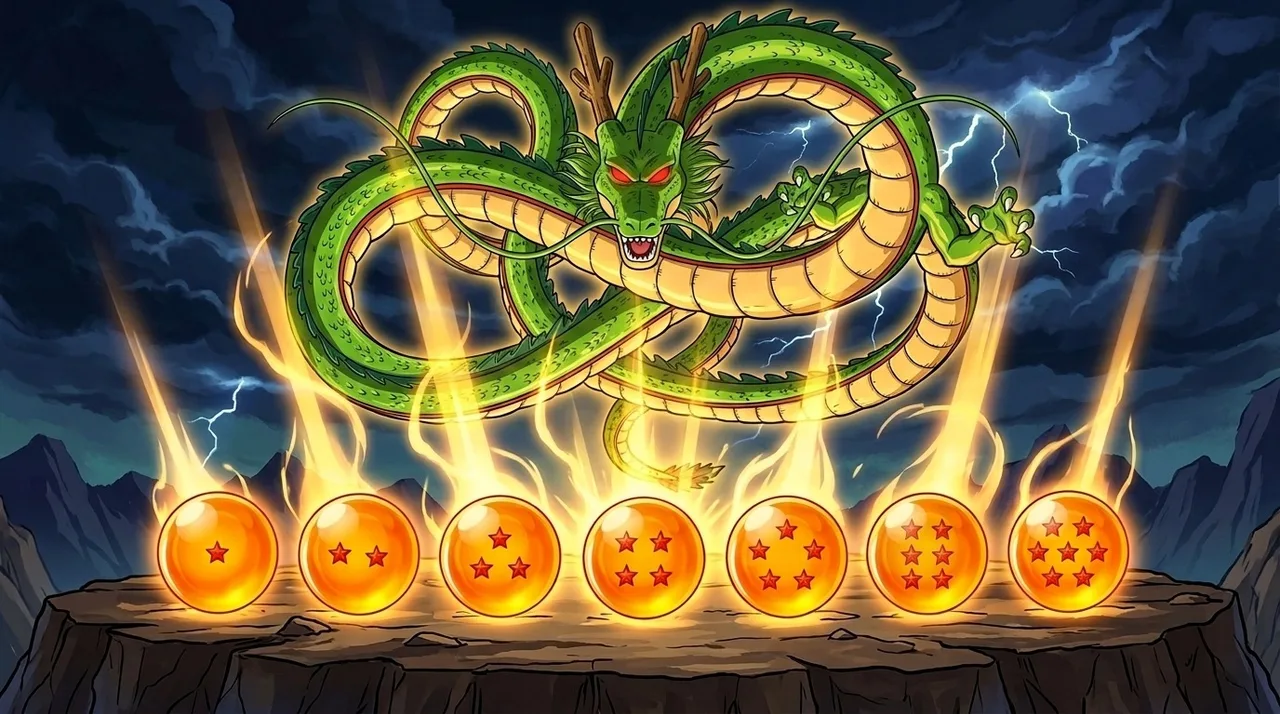
The Dragon Balls are the engine of the whole saga: seven orbs, each marked with one to seven stars, that summon a wish-granting dragon once they are brought together. Goku only meets Bulma because she is hunting for them in the very first chapter in 1984, and forty years later they still kick off the plot of Dragon Ball Daima. Here are the rules, the loopholes and the wishes that changed the story.
Where they come from
Toriyama wanted to give readers of a boys' magazine something to collect, a scavenger hunt they could follow week after week. The idea came from a Japanese classic, Nansō Satomi Hakkenden, in which the heroes recover eight prayer beads scattered across Japan. He settled on seven balls precisely so he would not copy the number from his model.
Inside the story, Earth's Dragon Balls were made by Kami, a Namekian who landed on Earth as a child and modeled them on the set from his home world. Much later, Elder Kai explains that wish-granting orbs were seen as a source of chaos, which is why only the Namekians, considered the most honest race in the universe, were allowed to create them.
Shenron's rules
Earth's dragon is Shenron, from the Chinese reading of 神龍, "divine dragon". His rules come out bit by bit:
- at first he grants a single wish;
- right afterwards the balls scatter across the planet and turn to stone for a year;
- he cannot do anything beyond the power of his creator: when Oolong asks him to defeat the Saiyans, Shenron flatly says it is impossible;
- he cannot revive people who died of natural causes, nor bring back the same person twice, which is why Goku cannot return after the Cell Games;
- if the creator dies, the balls become ordinary rocks. That is why Goku spares Piccolo at the 23rd World Martial Arts Tournament: his life is tied to Kami's.
When Dende replaces Kami as Earth's guardian, he upgrades the dragon. Shenron now grants three wishes, although a mass resurrection uses up two, and unused wishes can be saved for later, with the balls reactivating after four months. Daima adds a funny wrinkle: the three wishes are a perk for regulars, so the demon king Gomah, summoning Shenron for the first time, only gets one.
Namek and Porunga
Namek's Dragon Balls are much bigger and summon Porunga. The Namekian dragon grants three wishes, but he requires a password and requests spoken in the Namekian language, a detail that becomes crucial when Frieza, who does not speak it, reaches the dragon. Once used, the balls stay inert for one Namekian year, which is 130 Earth days.
Originally each wish could revive only one person. After Grand Elder Guru, who created the set, dies and the role passes to Moori, Porunga becomes able to restore entire groups. Guru's death also comes at the worst possible moment for Vegeta: the dragon vanishes just as the Saiyan prince is about to be granted immortality.
The Black Star Dragon Balls (GT)
Dragon Ball GT introduces balls with black stars, made by Kami before he split from King Piccolo, back when he was far more powerful. They summon a red dragon, Ultimate Shenron, who grants one wish without limits. The catch is brutal: after use the balls scatter across the universe, and if they are not brought back within a year, the planet where the wish was made is destroyed. The whole series starts with an accident, as Pilaf turns Goku back into a child by mistake. In its finale GT adds a new idea: every wish loads the balls with negative energy, and that energy gives birth to the Shadow Dragons.
The Super Dragon Balls
Dragon Ball Super reveals that every known set comes from fragments of the Super Dragon Balls, created by the dragon god Zalama. They are the size of planets, scattered across Universes 6 and 7, and only a deity can gather them. Their dragon, Super Shenron, can grant any wish at all, as long as you know the password and speak the language of the gods. They are the prize of the Tournament of Power, and they are how Android 17 brings the erased universes back. In Future Trunks' timeline, on the other hand, Zamasu uses them to swap bodies with Goku, which is how Goku Black is born.
The Super manga also features an unusual set on planet Cereal: just two balls, which never turn to stone. Granolah uses them to become the strongest fighter in the universe, paying with most of the years he had left to live.
Daima's Demon Realm Dragon Balls
In Dragon Ball Daima the Demon Realm has its own set, created by the old Namekian Neva. There are only three, they are enormous, and nobody needs to look for them because everyone knows where they are: each one sits in one of the three Demon Worlds, guarded by a Tamagami, a protector built to be unbeatable. The dragon they summon looks like Porunga, but red with yellow eyes, and once again wishes must be made in Namekian. Glorio, who had secretly learned the language, uses the wish to turn Goku and his friends back into adults.
The wishes that made history
| Wish | Who made it | Dragon Balls | Series |
|---|---|---|---|
| A pair of panties, to beat Pilaf to it | Oolong | Earth | Dragon Ball |
| Restored youth | King Piccolo | Earth | Dragon Ball |
| Revive Goku to fight the Saiyans | Master Roshi | Earth | Z |
| Revive Piccolo and bring him to Namek | Dende, for Gohan and Krillin | Namek | Z |
| Send everyone to Earth except Goku and Frieza | Dende, at King Kai's request | Namek | Z |
| Remove the bombs from Androids 17 and 18 | Krillin | Earth | Z |
| Erase humanity's memory of Majin Buu | Goku | Earth | Z |
| Turn Goku back into a child (by accident) | Pilaf | Black Star | GT |
| Swap bodies with Goku | Zamasu | Super | Super |
| Restore the erased universes | Android 17 | Super | Super |
| Turn Majin Buu's opponents into kids | Gomah | Earth | Daima |
| Make everyone adults again | Glorio | Demon Realm | Daima |
Did you know? The first wish we actually see granted is also the silliest. To stop Pilaf from ruling the world, Oolong blurts out his own wish first and asks Shenron for a pair of women's panties. The dragon obliges, and Pilaf is left empty-handed.
Beyond the rules, the Dragon Balls work as a pact with the reader: in Dragon Ball death can be undone, but every resurrection comes with a cost, a deadline or a loophole. That balance, more than the dragons themselves, is what has kept the tension alive for four decades.