
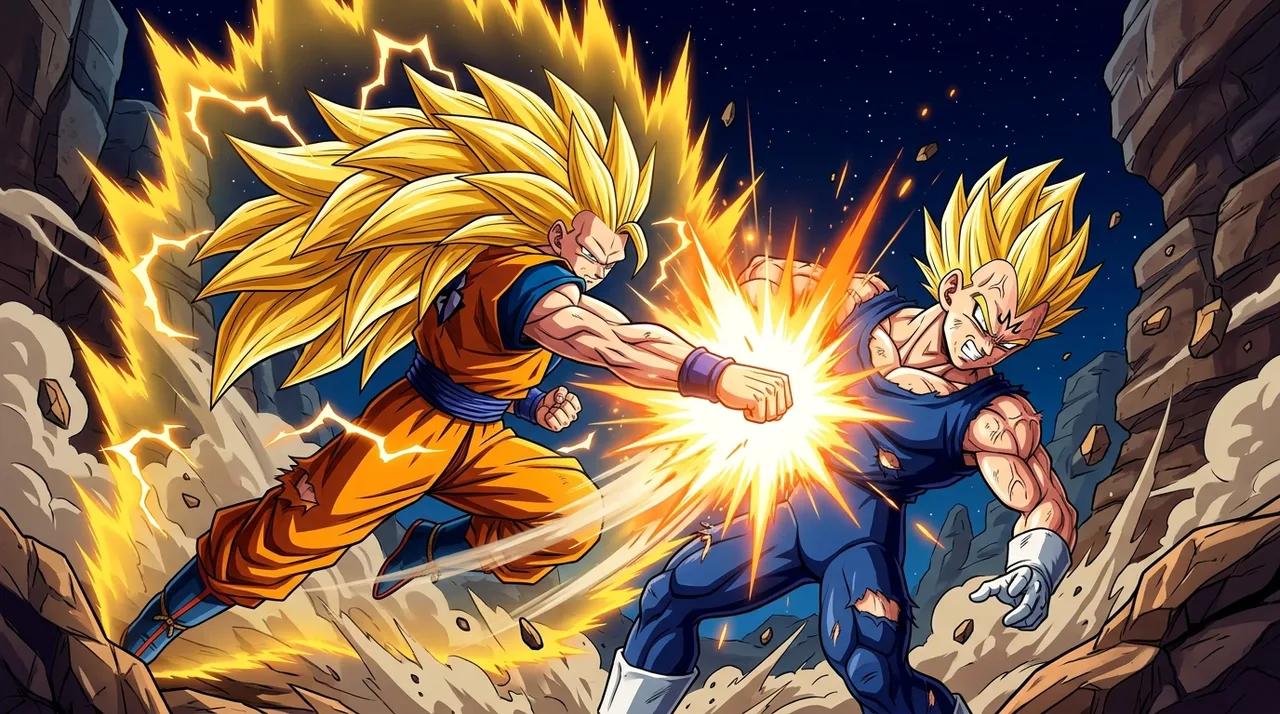
Dragon Ball Z: Budokai 3 is the third and final chapter of the Budokai trilogy, developed by Dimps for PlayStation 2. It came out on November 16, 2004 in North America, shortly afterwards in Europe, and on February 10, 2005 in Japan, where it is simply called Dragon Ball Z3. It is widely seen as the high point of the series: faster and flashier than its predecessors, with a roster that drew on GT and the movies for the first time.
What it is and how it plays
Unlike the Tenkaichi games that followed, Budokai 3 sticks closer to fighting game tradition: two fighters, one arena, a side-on view and cel-shaded 3D models. The most obvious addition is free flight: double-tap the d-pad to rise or drop at any moment and take the fight into the sky.
The energy system was rebuilt from scratch. Each character has a "base" ki level that their energy drifts back to on its own: above it you hit harder, below it your defense suffers. Transformations no longer drain ki; they raise the base level instead. Then come the mechanics that made the game famous:
- Hyper Mode: your fighter glows red and shrugs off normal hits but cannot block, and it is the only way to launch finishing moves;
- Dragon Rush: a three-step sequence where attacker and defender each pick a button; if the defender guesses right, the assault stops;
- Ultimate attacks: a button-mashing mini-game that decides how much damage gets through;
- Beam struggles: when two energy waves collide, whoever pushes harder wins;
- Fusion and Potara: available to a few characters, with a mini-game to nail the dance.
Moves are unlocked through capsules. Every character has seven slots to fill with techniques, transformations and stat boosts, a customization system that rewards long-term play.
The Dragon Universe
Story mode, Dragon Universe, is the reason so many people remember Budokai 3 fondly. You pick one of eleven characters and fly freely across a map of Earth or Namek, collecting capsules, money and Dragon Balls between fights. Events run from the Saiyan Saga to Majin Buu, but each character gets their own take: Goku can face Broly and reach Super Saiyan 4, Vegeta gets a similar alternate path, and you need several playthroughs to unlock everything.
The roster tops 40 fighters from Dragon Ball Z, GT, the movies and even the original Dragon Ball: Kid Goku, Bardock, Cooler, Broly, Uub, Super Saiyan 4 Gogeta and GT's final villain are all here.
Reception and editions
It was the best-reviewed Budokai: 77 on Metacritic, 8.2 from GameSpot and 8 from IGN, which praised its cel-shading and special effects. The Academy of Interactive Arts & Sciences nominated it for Fighting Game of the Year at the Interactive Achievement Awards.
Later editions added extras. Europe got a Collector's Edition in autumn 2005 with a selectable Japanese voice track and content from the Japanese version, while the US Greatest Hits reprint received similar additions. In 2012 came Dragon Ball Z: Budokai HD Collection for PS3 and Xbox 360, bundling the first Budokai and Budokai 3 in remastered form, with a new soundtrack and optional Japanese audio.
Did you know? The original American strategy guide listed two extra capsules with movies to unlock, but those files never existed on the disc: plenty of fans hunted for them in vain.
Who it is for
Players who want a Dragon Ball fighter that is more technical and less chaotic than the Tenkaichi games: a small roster by today's standards, but every character is carefully built, and exchanges are quick and readable. If you prefer creating your own fighter and taking on missions, Dragon Ball Xenoverse 2, also developed by Dimps, is the better pick.
Our take
Budokai 3 is where Dimps found the balance between faithfulness to the anime and pure fun. The rock-paper-scissors Dragon Rush may look naive, but it turns every clash into a mind game between two people on the couch. Its menus and structure show their age, yet it holds fourth place in our ranking of the best Dragon Ball games.